skip to main |
skip to sidebar
The Hunt
As email marketers, we should ALL be designing our communications with the assumption that our messages will be delivered with the default rendering "images off." Most email clients, unless the recipient has added you to their "safe sender" list will be delivered without the images "on." One way to get your communications viewed in their full HTML glory is to ensure that your image ALT tags are coded correctly and have a few words that reinforce what the image represents within your message. This is very critical if your call-to-action is an image however; using text/image based call-to-action is not something we would recommend.
The Skunk
While triaging a slew of personal emails via my Blackberry device the other day, I happened across an email from one of my favorite retailers - Molton Brown London. They produce a line of luxury soaps, candles, shave creams, colognes, makeup and such. Molton Brown has a global presence and I know that they send emails to both recipients in the UK and US markets (and other global markets I assume.) As I was scrolling through their message on my Blackberry, the first thing that caught my eye was that the ALT tag for their call-to-action listed was a UK based "free-phone" number (aka "toll-free number") instead of the normal 800 number for the US.
The odd ALT tag prompted me to save this message and review on my laptop. I had added their sending email address to my address book many months ago so the only way I would have noticed this is reviewing on my Blackberry. For Molton Brown’s email recipients that have not added their sending address to their personal white list, the message as it was delivered looked very different than the fully rendered HTML. Looking at the message further with images off, there were a few other HTML programming best practices that they need to apply to ensure that their messages are being opened by their recipients. Take a look at the message below with images on and off.
The Resolution
Let’s start with the image ALT tags. Of the 13 images contained within the message, only 3 were tagged with image ALT tags. As we all know, an ALT tag serves as a little description of what the image contains. In this case, 2 of the call-to-action images that were suppressed in the header and footer contained what should have been US based toll-free number to order via phone. During the QA process, they most likely forgot to switch out the ALT tag to the appropriate number. With images off, not only did the recipient not see the supporting product images, they don’t get the correct number to call to place an order. This could lead many recipients to think, "this message was not intended for me."
The remaining ALT tags were not populated with anything and leaves the recipient guessing as to what the big empty image boxes should be displaying. Except for a brief introductory paragraph in the top of the message, the call-to-action is virtually lost.
One other item of concern is the use of white fonts over a dark background color. Although some consider aesthetically pleasing, if these background colors are suppressed within the massage (as they could be in several email browsers) any critical information contained in these copy blocks will simple not appear on the screen. For this message, the housekeeping notes at the top of the message that invite the user to click if they don’t see the full message as well as white listing information do not show up. Other important links as well as terms and conditions are formatted in a white font over dark background in the footer of the message as well. These critical links, although there, do not render when the background color is suppressed. This is particularly important when the recipient cannot see the link to unsubscribe.
The moral of the story is, make sure that you are testing each version of your message and looking at your ALT tags. Programming/testing only once for one segment will limit the effectiveness for other segments if they are getting the wrong information. Use image based text call-to-actions sparingly and be sure that these are not the only call-to-actions within the message. Don’t forget to tag ALL of your image ALT tags, the recipient will use these to help determine if they want to interact with the message. Last but not least, if you are using a colored background, don’t forget that whenever these background colors are stripped out, using a white or light font will either result in no text rendering or text that is impossible to read.
Simple mistakes can lead to big problems when your message is delivered to your recipient's inbox. Put together a QA check list that covers all aspects of message testing and religiously complete these testing procedures for each and every message that you send.
The Hunt
I think we are all looking for ways to make our dollar stretch these days. Being a small business owner I source my minimal home office supply needs to many stores within the area. Ink cartridges for my printer, pens, notebooks, file folders you name it, I'm always looking to save a few bucks and get a great deal.
The Skunk
I enjoy Office Depot; they provide me a wide selection of goods and there is a location just minutes from my home. I have been receiving email from them for some time. I have recently noticed that the content of the messages they are sending me don't really fit into what I would normally be looking for to help keep my home office fully stocked. I'm not even really sure how I came to be on their email distribution list, perhaps I gave them my email at point-of-purchase?
In any case, this retailer serves both the individual that needs to pick up basic small office supplies as well as larger organizations that require big quantities. This message landed in my in-box recently and most of everything featured in the communication were in quantities that are way too large for my needs or not relevant to me at all. Yes, I know, this is just a marketing email and perhaps I'm asking a bit too much, but I think there are a few ways to help make the messages they send resonate specifically to me.  The Resolution
I went back through the sign-up process online to see how I could classify myself as a customer. My two choices were a) personal, and b) business. These are a little too generalized to leverage my response for message targeting at a relevant level. A better solution would be to ask (or survey) your members just how much they usually spend on their office supplies or provide additional classification on what I need/want from Office Depot. If you knew me just a little better, you wouldn't be trying to win me over with a deal on a big case of copy paper or 15 rolls of paper towels for my home office.
There is an offer for HP printer cartridges which is not being generated on previous purchase behavior...I have an Epson. But what a great opportunity to find out (via online survey) what type of peripherals I do use in my home office. I would love to get special offers for items that enhance or compliment equipment that I use on a regular basis.
By asking recipients or giving them the opportunity to provide more information about their needs, marketers can leverage increased relevancy within their messages and delver communications that suite the individual recipient's needs. If a customer has signed up to receive special offers, make sure they are offers that are of interest. If you don’t know what they want, ask.
The Hunt
We all feel the need for speed - with faster internet that is. More bandwidth to get information to and from your customers, blazing fast downloads and quicker uploads for more data intensive applications. Fiber-optic internet into the home/office will help to get everything moving just a little quicker. This might be the next generation of connectivity that everyone is clamoring for but make sure that with any type of product announcement the information that you are emailing to your customers is classified and positioned in the correct way.
The Skunk
My internet service provider just informed me that their new fiber-optic internet service will soon be available in my area (see message below). Hurray for me! My concern however is that they consider this a service-type email communication and not a marketing piece. They will not allow me to opt-out of future emails - and they actually tell me (in small print) why I can't remove myself from these types of messages. Now I know this is a service that they plan to offer but why wouldn't they give me the opportunity to remove myself from future communications regarding this type of service if I’m not interested. This is a marketing piece to upgrade my service, not a critical message that affects my current service. It's not related to a bill, payment or any type of possible service disruption. I should have the option to opt-out.

The Resolution
First things first, know and classify the types of messages that you are sending based on the content. In this case, the message that was sent is a marketing message that talks specifically about how I can upgrade and spend more money with the internet provider. This is all fine and good, but this in no way affects the continued service into my home/office if I choose not to interact with this message, it is simply an offer.
Second, do I really have to verify if the service is available in my area? They mail me a bill each month and they surely know my address and zip code so why not build out that messaging dynamically with a custom message based on this information? They know darn well if the service is or is not available to my residence – so it is a "teaser message" and that's ok – I'm excited at the prospect of fiber optic connectivity but position it as such.
The only types of message that can circumvent the inclusion of an opt-out are true transactional messages - you buy/download/transact with an online merchant or organization, you get a confirmation message. Even electronic statements should have some sort of opt-out or email communication settings. The onus is on the provider to deliver these types of account updates in the manner that the recipient chooses.
If this message was to tell me that I would be switched from a regular cable modem to the fiber-optic system (and I had no choice) then you could legally remove the CAN-SPAM compliant one-click opt-out but every message that you send should have the ability to modify your email subscription settings to help the customers maintain their messaging frequency from you - period!
The Hunt
I'm not sure when being connected becomes more of an addiction rather than a necessity but it happened to me a few years back. The thought of being without my mobile device sends anxiety pains right through me so it is no surprise that when I heard rumblings of the new Blackberry App World I started salivating like one of Pavlov's dogs. For mobile device die-hards, it's not just about the equipment; it's about what new and great things you can do with it. Sign me up!The Skunk
One of the key selling features for my new Blackberry was that my perception of these types of devices is that they are geared for the business user. The trade-off when compared to the iPhone, applications created for these devices are not as varied or robust as those on the open platform that Apple has created for the iPhone. Enter Blackberry App World. This past month I received two messages to sign up and be one of the first to be notified when this new service is available. My first official message was on March 6; I promptly followed the link and signed up. A second email came on March 26 which came with a similar call to action. The issue with the second email is that I had already signed up and there was no new news on when I could expect this service to be live. Kinda frustrating right?  The Resolution
Besides the obvious question, why are you asking me to sign up twice, I hoped that the second teaser message had additional information about when I could expect this service to be up and running. I'm a huge Blackberry fan and will most likely post the launch of this service to the social sites that I belong to but with little or no information on when the live site is expected, these types of "hurry up and wait" communications become more inbox clutter than informative.
Another point with this messaging strategy is that I'm already subscribed to receive email communications from Blackberry - the reason I got the original message. Beyond building the "buzz" will there be any differentiation between the types of message that I've now signed up to receive for my initial notification of the launch versus the regular marketing communications that will be sent to regular subscribers? I'll be keeping an eye out and yes, I will be the first in line when App World opens.
The Hunt
Pizza has always been and forever will be considered a food group in my eyes and although I limit my crusty cheesy-pie intake to help keep me fitting into my favorite blue jeans, it's no secret that I'm a diehard pizza fan. With email playing a bigger role in not only the pizza world, I regularly sign up for email programs from local (and not so local) food deliver chains to see how they leverage the email channel. The Skunk In my early twenties this pizza joint was one of my favorites - I just grew to love it. As I got older, and moved around from city to city, I made sure to check out what the area had to offer when it came to pizza-in-a-pinch but I knew that I could always call this place to get a good deal and a yummy meal. A few months ago, I was doing a little bit of "pie research" on the web and happened upon a location that wasn't in my delivery area but decided to drive the 6 (in-town) miles to pick up one in person - just for old times' sake. Just as good as I remembered. I signed up for their email program and get a weekly message with a special offer and invitation to place my order online. So my little issue with this email-program-that-could is that the call to action is to place my order online. I'm outside of the delivery area (and not just a quick drive for pick-up) so the likelihood of me ever ordering online is pretty much zilch. The emails that are delivered regularly to my inbox are just a tease and a delicious one at that. The Resolution Before you ask, yes, they know what my address is; I completed my full profile after sign-up. I think the better approach would be to send me an occasional (monthly) email since I'm not in the delivery area. I don't get many chances to visit the area where this store is located so repeated messages that I or others like me can't act upon are most likely a little detrimental to their email program.DO send me an email if a store opens up that is closer to where I live or within my delivery area. I might not get to travel regularly to where this particular store is located but giving me a few other options would be great if I happen to be around one of their other locations.At the end of the day, the information that you collect about your recipient should be used to provide the best customer experience possible. Clients often ask me what they can do make their emails better. The answer is simple; look at your email messages as if you were your customer. Good email programs can be made great by adjusting them along the way.
The Hunt
One of my favorite retail spots to visit on the weekend is this great furniture retailer. They have locations in over 10 states and send a few emails a week - I little too frequently if you ask me but I take a quick read when it lands in my inbox. Today I got an email with an invitation stop by for a quick decorating class this coming weekend. If you are like me, the process of home decorating is an ongoing effort so considering to register for this freebie is right up my alley.The Skunk
So, these past few months I feel like that I've been doing my part to help stimulate the economy with some decent sized purchases from this retailer and I know that I'm in their "system." As an email marketer, I'm always thinking about how to reduce the barriers between the message call-to-action and the actual physical steps that the customer needs to take to accomplish. It's an electronic world and technology is ripe for the picking to help out with these types of endeavors. My question, why can't I register for this fun little class online? For me to complete the call-to-action, I need to go to the website, find my location and actually call the store directly. Seems like a bunch of steps for me to complete before I can sign up for this little shindig. The Resolution
There are a few strategies with this message I would have leveraged. Some not so technical, some a little more involved. All could take a little bit of the hassle of signing up for this class. - If you know what location I shop at, why not list the contact information for the actual store in the email? If this information doesn't live in the database, it should.
- The process for online registration does take time and money to set-up. If the budget was too small to use this type of technology to register folks online, make sure to boldly call out that you'll need to contact the store directly to sign-up. Dumping me at the website to have to pick my state and location seems a little impersonal and confusing.
- What could online registration have done to simplify the process? Well, for one, provided real-time updates on the number of attendees. Consider the staff that will now have to field the calls to facilitate the reservations; they might be better off schmoozing with the customers on the show room floor.
- Take advantage of learning more about your customers by using registration data to append to your database. There is a pretty good chance that if I’m signing up, I'm much more of an engaged customer that those that are not.
- Reminders and remarketing can help close the loop. A quick reminder message the day before and perhaps a thank you once the event is over would be a great touch.
Your best customers need to be treated as such. Email is a great relationship tool but if you are not going to use customer history and data to make your communications better you'll leave them feeling a little unappreciated. Leverage technology to help facilitate a true on-to-one communication flow with them and they will be loyal for life.
The Hunt
I've been in the market for an easy to use fax-to-mail account to supplement by business fax needs. There are a few well known providers out there and all pretty much have the same features compared to one another. As I was sizing up the different providers that had a relatively economical price-point and easy account set-up, I found a service called myFax that seemed to fulfill all my requirements. Tempted by the complimentary 30-day trial, I clicked on the sign-up form and started inputting my information.
The Skunk
I had already picked an area code for my new fax number and entered in my name and email before I continued to the page that requested my credit card information. Trial or not, credit cards mean commitment and I decided not to pull the trigger just yet and do some more research. Up to this point, there was not a check box (to mark or un-mark) for receipt of future emails from myFax but, since they had my email now, a follow-up from the abandonment process wouldn't be a surprise.
As I thought, a message arrived in my inbox a few hours later as a friendly reminder that it was free to sign-up along with some other points that separate them from the "other guy." The sender was a female persona "Tara" but oddly enough, the image rendered in the communication was male. I wasn't sure if this was the "person" that was sending the sign-up reminder or what. Nonetheless, I can't blame them for trying to close the deal with a follow-up message but this and two other messages from them within 24 hours seemed to be a bit much. I hadn't converted and I'm already getting messages on how to use myFax? Oh, and the subject line read "Colleague, subject line..."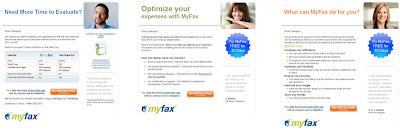 The Resolution
Kudos to myFax following up with an "abandon cart" type of message - striking while the iron is hot is a critical messaging component to win the business when the prospective customer is shopping for this type of "instant service." Here's how I would take a bit of the skunk out of what we received.- Be upfront about sending a follow-up email, use a check box or inform the registrant that they WILL be getting a future communication if they so choose.
- I don't know the sender "Tara" but since I would surely be familiar with the company name, use it.
- The use of the generic "Colleague" both in the subject line and in the salutation in not personal. If you are not going to use the person's name reconsider the "personalization."
- I perceived the headshot picture to be (should have been) of the person/persona sending the message. There were three unique images used - both male and female - all from Tara.
- Consider the frequency. Even after two messages, as a non--convert, you run a high risk of future communications being reported as SPAM by the recipient. This could pose a deliverability issue for other messages going to your regular customers as well as those you are looking to convert.
Remember, the difference from a skunk to a sweet smelling email program or campaign can be just a matter of tweaking a few critical variables and messaging components. Look at your communications as your recipients would review them.
The Hunt
If I had a nickel for every time I’ve read or heard the word “relevance” when referring to email marketing well, I would have a lot of nickels now wouldn’t I? I’m not staying that this isn’t an issue that doesn’t need to be addressed but it seems to me that this concept of “relevancy” gets more lip service than elbow grease. I get it - times are tough and headcount is down – more with less. We all have to make do with the resources at hand but let’s think through our messaging – you, me, everyone.
The Skunk
Depending on the source and what year you can find a statistic, about 60% of US households own a pet. Dog, cat, spider monkey, I’m not sure about the breakdown of who owns what but that still leaves about 40% of the population that doesn’t own a pet and even more that don’t own one with four legs.
The message below from another one of my favorite retailers missed the “relevancy” mark. I don’t currently own a pet (previous fish owner hence the title of this blog) and I’m pretty sure that this particular retailer doesn’t have any information about me regarding the ownership of pets. Subject line reads – “Shop for your four-legged friends.” Sure, I could potentially be interested in a gift for a friend or family members pooch or puss, but for me this message was quickly disregarded as irrelevant to me. The Resolution
Pet owners love their pets. Non pet owners, well they probably like your pet but don’t kid yourself. For more impact I would have focused on a few messaging components to really tighten up the relevancy quotient.
- If at all possible, focus on those in your database that have pets (specifically ones with four-legs that can use the products that are available online) either by adding this to data collection during the email acquisition process or surveying your member database.
- “Four-Legged Friends” has a general connotation of being canine or feline. The imagery in the top of the message is focused primarily on man’s best friend. Better to have included imagery for both types of pet owners so that when they are quickly scanning the top of the email they can determine if the message has meaning for them.
If you know your message will be irrelevant or of no interest to some of your recipients, weigh the risks. Opt-outs or SPAM complaints received due to messages that don’t resonate with the recipient are not worth the risk in today’s overcrowded inbox.
The Hunt
OK, I admit it; I'm a sucker for an online survey. I'm not sure if it is the diversion, the "you could win' proposition or simply being able to give my two cents...I love'em. While sorting through my inbox during my morning coffee I was excited to spot a survey from one of my FAVORITE magazines, Bon Appétit - I sure that it needed my immediate attention. Note: The publisher should be happy to know that flipping through every new magazine is a little bit of heaven and I'm usually on their website looking at recipes at least three or four three times a week.
The Skunk
The email was legit and contained all the introductory pleasantries that one would expect in the set-up; "since you are a valued reader," "we value your option” etc. We were off to a great start! The thing about online surveys is that even though it is a fun diversion, not informing me of how long it will take before I click on the survey link doesn’t help me determine if I should start now or save for a time that I'll be able to really focus. I started anyway.The questions start off as usual and there was even a note on the first survey page that mentions that you don't need to complete the survey to enter the contest? Advancing page after page, I couldn't help think that some sort of progress tracking icon would have helped me determine just how many pages I had left to go. At a certain point, the thought of abandoning the survey or checking any random box was becoming more of an option but I didn't want to offend the survey gods that might perhaps be tracking my progress and retaliate in a next life. About 50 "Nexts" later, I was finished.
 The Resolution
I don"t profess to be an expert on how to execute and administer surveys but as an email marketer, I do like to give recipients as much information as possible when I"m requesting some sort of interaction with them. Yes, I completed the full survey but as I got deeper into the questions, it became more of personal test to see if I could make it to the end. Who knows, maybe that was part o the strategy? Be careful with really long surveys, you may compromise the data you are collecting if recipients don't take the time to accurately complete. Here's what I would have done:- Clearly noted in the initial email about how long that it would take to complete once I start
- Stated if it was possible to leave the survey and pick back up where I left off
- Placed some sort of completion status bar on each page to let me know how far along I was in the process
Incorporating some or all of the points above should be pretty easy to accomplish based on additional copy and making sure you are using the right survey tool for larger surveys. The same set of rules that we apply to setting expectations in email need to be applied those call to actions that we include within in the content; clear, relevant, informative and effective. My best advice with surveys is to take a step back and consider the surveyee. Make sure they know what they are getting themselves into.
The Hunt
This past Thursday I received an interesting email from the popular web-based photo sharing site Snapfish. It said to keep an eye on my email for a very special offer for President’s Day. I thought wow, what an interesting way to build some momentum for a future “exclusive” campaign. It was unobtrusive and teased with just enough information to make me want to check my email on Saturday – the day to look for the special offer. The teaser message stated “As one of our best customers, we wanted to let you know that you'll be getting an amazing President's Day Weekend deal on all of our gifts!”
The Skunk
So I got the email on Saturday but I didn’t think that the promise lived up to the hype of the previous teaser message. Free shipping on Photo Gifts? That’s it? The “special offer” is viewable when I login to the website as well. The teaser message and the offer message are below. I was anticipating some sort of great exclusive offer that would have really peaked my interest and incented me do a little online shopping. The Resolution
When pushing an exclusive offer with a teaser message you really need to follow through with your promise of an offer that packs a lot of punch since so many online retailers are currently providing deep discounts to incent customers. Free shipping is nice and all but if customers new and old can get this offer by simply logging on to the website, how exclusive is it? The offer needs to be perceived as a great value and it can’t be confusing. Too many terms and conditions can also create a roadblock to purchase as well. When sending out a teaser for an upcoming email offer, keep that promise of value and exclusivity. If the offer is not unlike previous offers, the teaser message can be more of a turn-off than attention grabbing and interest building.
The Hunt
We've all been there, standing in front of the sales person and completing your purchase when you get the question - what's your email address. I get that "deer in headlights" look and think, what am I getting my email inbox into?
The Skunk
Last weekend while doing a little retail therapy, I happened into my local Bath & Body Works. I wasn't looking to purchase anything in particular but started to sniff around anyway. A $30 impulse buy later, I'm giving the sales person my email address right after I forked over my credit card. Let me first start by saying that I'm impressed that my email made it to their distribution list in less than 5 days. With such a big retail footprint however, it would have been a really good idea to make "introductions" first. I’m sure that I am just one of thousands that made their way to their database and starting off on the right foot can be the difference between engaged and indifferent customers when it comes to engaging in their email program.
The Resolution
As retailer go, they get credit for striking while the iron is hot however, they missed an opportunity to welcome me to their email program and give me the lowdown on what and when to expect their marketing messages. In general, collecting email addresses at the point-of-purchase a sure-fire way to grow your database, you just need take a step back from the process and ensure that the customer experience is on track as well. Ask a quick question while checking out, "do you want to receive special offers from us via email?" Yes, I know, the fact that they asked me for my email address makes it kind of obvious that I might be getting a message from them soon but perhaps a better approach is to start off with a thank-you-for-your-purchase communication. Tell me what I’ll be getting from you and how often I can expect to receive messages as well as giving me an opportunity to actually opt-in to the communication.
Nowadays, rapidly growing your database with customers that haven't confirmed an expressed interest to receive messages from you can ultimately have a negative effect on your deliverability. What happens when the auto-enrolled recipient becomes indifferent to your messages? You run the risk of your messages being perceived as SPAM, increasing chance recipients are going to complain, sending your email reputation right down the toilet. Your big list is not so big if no one is actually receiving your messages.
The Hunt
For those of us that live in climates with four seasons, the first time we have to fire up the furnace is about the time we start surveying our outerwear to ensure that we are prepared for the long and chilly road ahead. Retailers often start trying to move the merchandise even sooner. Cold weather gear starts hitting the shelves often times before I've stashed my flip-flops in the back of the closet. For email marketers, it’s all about timeliness, relevance and your approach.
The Skunk
So as the greater Chicago-land area is pushing nearly 50 inches of the white stuff so far this year, the message below with the subject line "Now's the time for Cold Weather Boots!" seems to have come a few months too late since I can already approximate the current month we are in by the size of the man-made snow piles in the mall parking lot.
Another missed opportunity in this message is the lack of actual images of boots. This retailer carries quite a few brands and boots are not something that I frequently purchase. Simply naming the brands within the message doesn't give me enough information to want to do any further digging. I don't particularly know all the brands but I can identify what styles I would prefer by looking at a selection of supporting product images. The Resolution
Take note of the seasonality of your message. The subject line needs to be relevant to the consumer - at the time they are receiving it. A better approach would be to have acknowledged that those recipients living in colder climates are still "knee deep" in winter rather than "now’s the time to buy" those boots. You would also want to verify that the message is reaching the right customers as well - Milwaukee vs. Miami - there is bound to be a difference in what they would find of interest.
Don't forget the product! Use product images to entice your recipients. If you are featuring boots, make sure that your call-to-action and message content reflects it.
The Hunt
You don't have to talk to many marketers before you hear the word "blast" roll off the tongue - at which point my left eye starts to twitch, my leg starts to shake and expletives begin to fly from my mouth like a raunchy truck driver after too much coffee. Graphic? Yes. True? Pretty close. For those of you that have worked with me, clients, prospects and colleagues alike you know that it has been my personal mission to ban the word "blast" from the email industry forever (much like the hyphen in e-mail, which is gaining success as well). Call me an email snob, but if you are a legitimate marketer the word "blast" should never pass your lips unless you are using it to describe the fun networking event you attended last night. Nothing about your marketing efforts should convey that there is no forethought or planning to your marketing and "blast" does exactly that.
The Skunk
Clearly the skunk here is the awful, five-letter dirty word that has made its way in to the vocabulary of email marketers everywhere --- BLAST. A word that so inherently indicates that we are an industry that doesn't care where our messages land so long as we hit someone with an email address and at least one good eye. One colleague likened it to confetti cannons – blast the confetti cannon and you will be cleaning up the mess for months! It’s not too far from the truth really. Look at this industry, email marketers continue to exist today that believe this is the right approach. Call it what you want, "spray and pray," "batch and blast," it is the behavior that has caused so much consumer distrust in email marketing and years later, we are still cleaning up the mess. It is this same mentality that has caused your friends to call you a SPAMMER after you tell them what you do for a living.
The Resolution
Let’s keep "blast" in the past and move into a new, more intelligent era of email communication where we refer to our email communications as campaign launches or customer email distributions. As professional email marketers we are mindful about message content that contains email "dirty words or phrases" like "free" or "limited time offer." The same consideration needs to be given to how we as marketers refer to what we do on a daily basis. We need to "walk the walk" by removing the word "blast" from our daily vernacular starting now. This will also help educate those internal customers that have a stake in your email marketing as well as making it a little easier for sweet old aunt Margie to better understand what you do.
The Hunt
When I sign-up for an email program I expect a few things based on the information that I provide to the marketer. If I am providing my address, personal preferences and the like, I assume that this information will be used to serve up email content that is more relevant than if I had only provided my email address. Savvy consumers today know that it is possible to really target the email you send, so if you are collecting personal information, you best be prepared to use it.The Skunk
I recently enrolled in the American Express Entertainment Access email program available through my card membership. Although purists would say that Chicago is not New York when it comes to plethora of Broadway, Off-Broadway and other great shows and events, Chicago does a pretty darn good job of providing a full spectrum of rich events to choose from for your entertainment pleasure.
<<personal rant – I’ll keep it brief >> This is one of my pet peeves - when I register for emails that require me to further clarify personal preferences even after I've provided my selections especially when my location should have already been identified by previous information supplied.<</ personal rant>>
I've received a few of these entertainment emails over the last few weeks, all referencing the exciting events that are available for me to book with my Amex card. They were all based on events in the New York area. The two things that are troubling to me is that one; you already know that I live in the Chicago area and two; I have to search within the email to change my preferences so that I receive offers based in my local area. Although not a painful process, I find it a little odd (and time consuming based on the additional steps required) that they would make me scour through a message and take further actions to make the email more relevant to me. Email should be quick and painless and provide the information that is expected. 
The Resolution
Knowing your customer means leveraging the data that you have on file; that you have previously asked for! In this case, my billing address reflects a Chicagoland zip code - what more do you need? If any additional selections are needed, these should be handled when I sign up for the communication, not after I realize that these events are not in my home city. If you are managing user information across multiple databases for your email communications, ensure that these systems can reconcile before messages featuring conditional content are sent especially when content is driven by the data. Another, less integrated, stop-gap measure would be to include a user-friendly, easily identifiable action within the email communication to self report and self request geographically specific information. Requiring your email recipient to click deeper within a communication to get more information about something that peeks their interest is great and is often a component for a successful message. Asking them to hunt for their relevant information can be extremely detrimental. If your call to action is not crystal clear, recipients will likely just move on…it's not like they don’t have another message (much like yours) awaiting them in their inbox.


 Posts
Posts

